
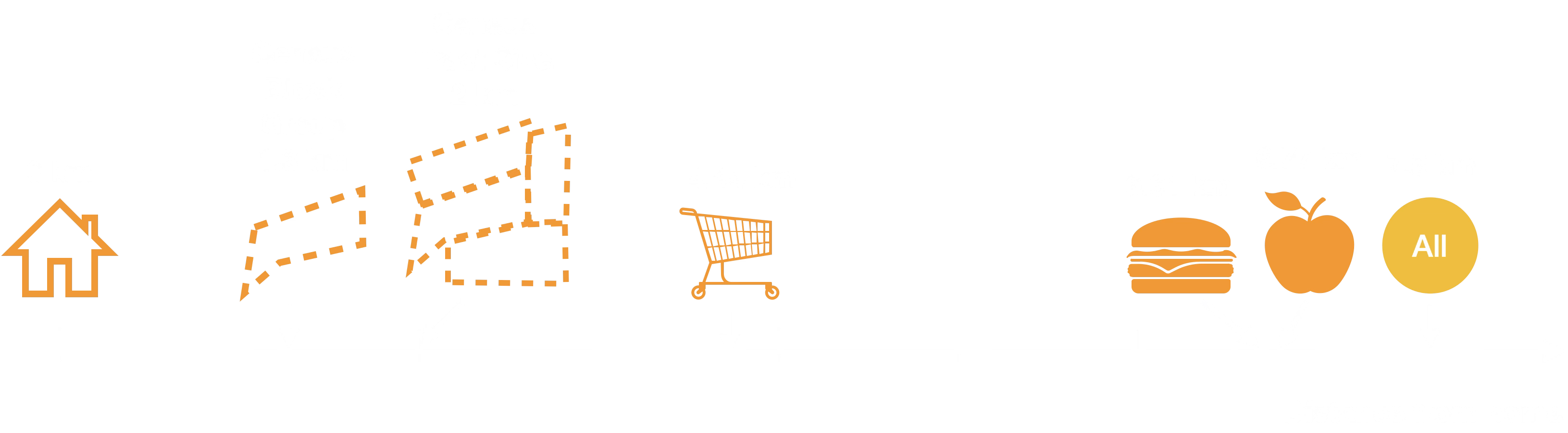
People rarely consume food near home. As the figure illustrates, the average distance between where people live and where they consume food is about 6–7 km, far beyond the spatial scales typically used to measure neighborhood environments. Yet most studies of the social determinants of health rely on static views of residential neighborhoods or demographic groups, overlooking the dynamic nature of human behavior.
At the Social Urban Networks Lab (SUNLab), we study how mobile food environments shape dietary behavior and health. Using large-scale mobility data, we reconstruct the food environments people encounter throughout their daily routines and link them to the food outlets they actually visit.
Our research shows that most food visits occur far from home, meaning that the environments people experience while commuting, working, or running errands are often more influential than their residential neighborhood. Exposure to fast-food outlets in these daily environments strongly predicts food choices: a 10% increase in exposure to fast-food options increases the odds of visiting one by about 20% [1].
We also show that mobility data provides meaningful indicators of dietary behavior and diet-related disease. Patterns of visits to fast-food outlets observed in mobility data correlate with fast-food consumption as well as health outcomes such as obesity and diabetes [2].
Together, this work highlights how understanding where people actually consume provides a new lens to study diet, health, and urban inequality, and offers tools to design more effective policies to improve access to healthy food environments.
References
García Bulle Bueno, B., Horn, A. L., Bell, B. M., Bahrami, M., Bozkaya, B., Pentland, A., de la Haye, K., & Moro, E. (2024). Effect of mobile food environments on fast food visits. Nature Communications, 15, 2291.
Horn, A. L., Bell, B. M., García Bulle Bueno, B., Bahrami, M., Bozkaya, B., Cui, Y., Wilson, J. P., Pentland, A., Moro, E., & de la Haye, K. (2023). Population mobility data provides meaningful indicators of fast food intake and diet-related diseases in diverse populations. npj Digital Medicine, 6, 208.